|
|
|


PhD Studentship in Computer Vision for location
based services sponsored by HPLabs Innovation
Research Award
*****We are no longer requesting applications for this post*****
Published August 2008
·
Call
·
The HPLabs Innovation Research Award
|
|
Call
We are looking for a motivated, hard working and
insightful student to research on methods that use Computer Vision and mobile
sensors to enable location based services.
This is a research collaboration
between the University of Bristol and Hewlett-Packard Research Laboratories
The project aims to develop novel methods for positioning
a mobile device using a combination of image based location sensing, inertial
sensors and external information such as GPS. The intended application is in
enabling location services and virtual augmentations.
The successful candidate will join the Computer Vision Group at
the Department of Computer Science,
where we have developed a number of real-time visual location and mapping
systems that we have applied to augmented reality and robotics. The
There are no restrictions on nationality as the
scholarship can cover overseas university fees and includes a stipend for
living expenses. Funding is provided by HP on a yearly basis subject to
satisfactory performance for up to three years.
We are looking for the finest candidate from anywhere in
the world to join our research team and invite interested students with a good MSc or undergraduate degree in Computer Science,
Mathematics, Physics or equivalent to apply. Applicants should have provable
excellent C and/or C++ programming ability (ideally in both Windows and Linux
OS), as well as strong mathematical skills. Experience with Computer Vision or related methods is highly desirable and awareness of
algorithm design in the context of mobile platforms would be a bonus.
The post will be filled when sufficient high quality
applications are received. Therefore, applying as soon as possible is
advisable.
We expect to start the project in October 2008 or earlier.
The
project lead and supervisor will be Dr
Walterio Mayol-Cuevas, in close collaboration
with a team of experts at the Pervasive Computing Lab at HPLabs
Bristol.
Please
see the section on Application Procedure
for further details.
Background Research
We
have developed a number of systems based in computer vision methods for
location and mapping. Below are
examples of the relevant work to this project.
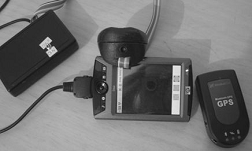
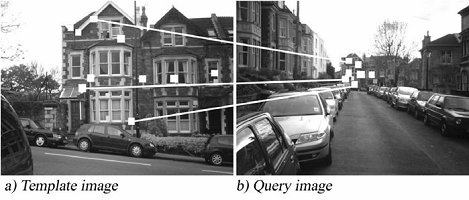
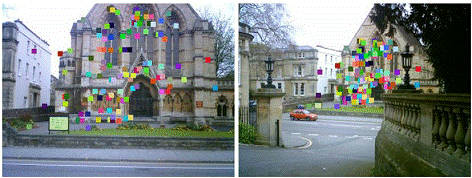
Figure 1. This work done by MEng student Robin Hutchings under the supervision of Dr Walterio Mayol-Cuevas, used a
mobile computer equipped with a camera, an electronic compass and a GPS to
detect buildings’ facades under occlusion and varying distances with a
computer vision algorithm made efficient for fast image matching. More details
are available in this technical
report.
Figure 2. This video shows a real-time
system that is able to use a camera to build a 3D map of the environment and at
the same time use this map for a virtual reality game. The system uses a single
camera and works at frame rate, performing both camera
pose estimation and map building simultaneously. A paper about this is available
here.
Application Procedure
Interested students that match the requested skills,
should send a cover letter containing a paragraph explaining their motivation
to do a PhD in this topic, a CV with a research statement and the name and
contact details of at least 2 referees willing to comment on the applicant’s
academic abilities to wmayol at cs.bris.ac.uk . Informal enquiries before
application should also be sent to this email.
Your CV must
include details of your academic qualifications and grades obtained, and
ideally a copy of the official transcript of your degree marks with explanation
of what the marks mean (i.e. 80 out of 100, or First Class). If relevant, formal
indication of your level of English should also be included (e.g. your
IELTS/TOEFL score). Note: applications are received
via the above email only, and if possible using a single document in PDF
format.
After a suitable number of quality applications are
received, a short list will be produced and if you are in this group we will
contact you to arrange an interview. Interviews could be made in person or via
telephone/web conference depending on applicant’s location. Please
include an indication on when you are available for interviewing in your cover
letter.
The selected candidate will then be invited to complete
the normal
As indicated above, we are keen to start this project in
October 2008, and therefore interested applicants are advised to apply as soon
as possible since competition for PhD places is usually intense, and the
arrangement of the formal application may take several weeks.
We encourage you to check this
page before submission to see if there is any new information.
The HPLabs
Innovation Research Award
The
HP reviewed more than 450 proposals from 200 universities
in 28 countries on a range of topics within the five principal research themes
at HP Labs – intelligent infrastructure, sustainability, information
explosion, dynamic cloud services and content transformation. A key element of
each award will be on-campus support for one graduate student researcher. More
information about the HP Labs Innovation Research Program and worldwide award
recipients is available at http://www.hpl.hp.com/open_innovation/irp/index.html
Further Enquiries
Informal
enquiries for this studentship can be made by contacting
Dr Walterio Mayol-Cuevas via {wmayol at cs.bris.ac.uk} with subject "HP Research
award".